
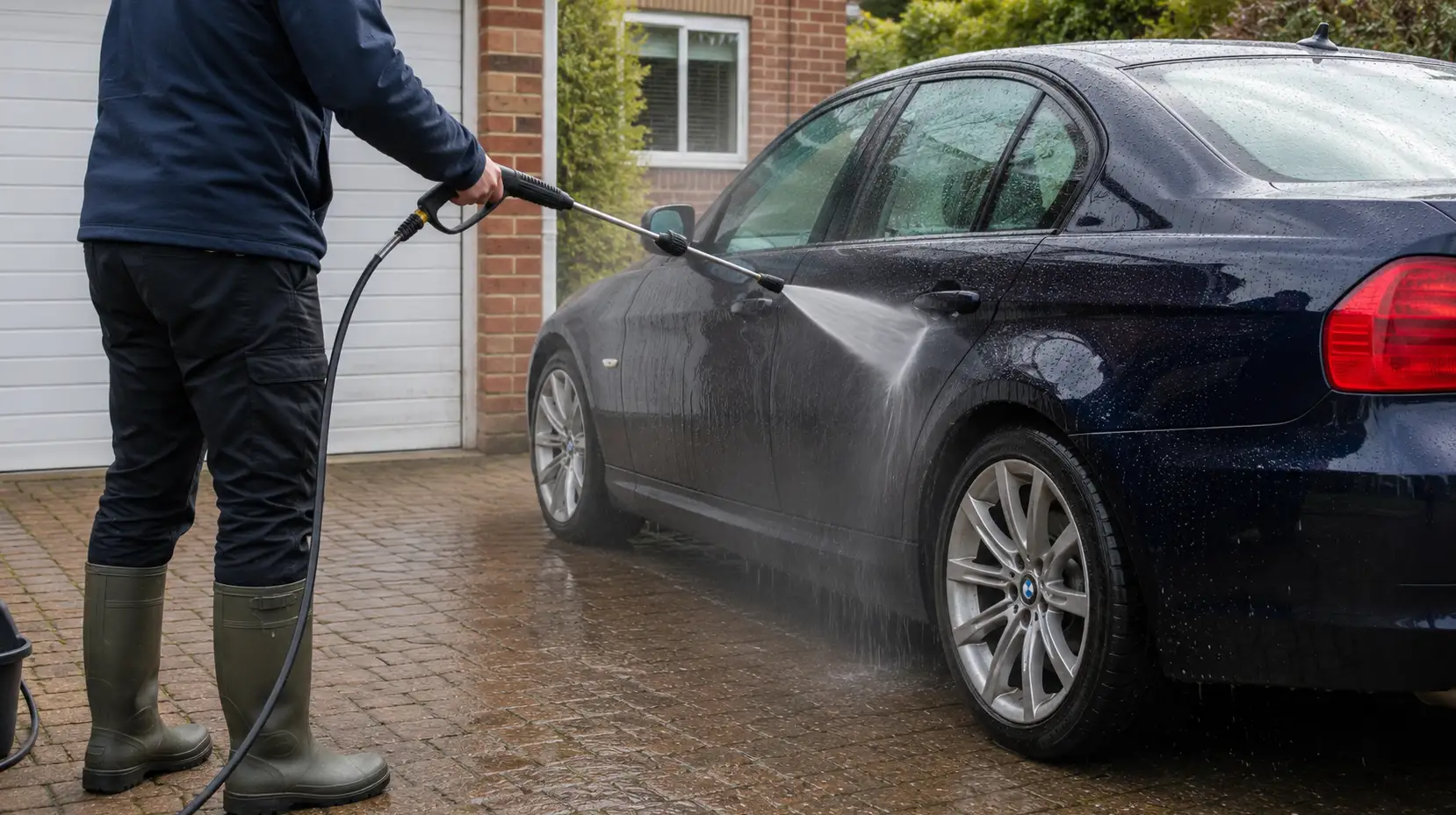
Yes. I use a pressure washer when cleaning cars and, used properly, I think it is one of the most useful tools for an exterior valet.
What I don’t do is treat a car like a patio.
The aim isn’t to fit the most aggressive nozzle, get as close to the paint as possible and keep increasing the pressure until every mark disappears. I use a pressure washer to remove loose contamination before I touch the paint, rinse pre-wash products, clean awkward areas and rinse the vehicle thoroughly afterwards.
It is an important part of the wash, but it isn’t the wash itself.
In fact, one of the main reasons I use a pressure washer is to reduce how much dirt I eventually have to remove by hand. Road grit and other particles can mark paint if they become trapped between a wash mitt and the surface. If I can rinse a large proportion of that contamination away first, that’s less abrasive material being moved across the paint later.
The RAC’s car-washing guidance recommends the same basic approach: remove loose dirt with a hose or pressure washer before the contact wash begins.
Why I use one
If a car is covered in road grime, I don’t want my first move to be rubbing a wash mitt over it.
I want to remove as much loose contamination as I reasonably can without touching the paint.
A pressure washer is particularly useful around lower panels, wheel arches, grilles, panel gaps and other areas where mud and road dirt accumulate. It also makes rinsing pre-wash products much easier.
But there’s a point worth making here.
A car can look remarkably clean while it is wet after a pressure rinse. That doesn’t necessarily mean it actually is clean.
Once the water disappears, you can still be left with traffic film and contamination bonded to the surface. Water pressure alone doesn’t always remove that.
That is why I see the pressure washer as a tool within the valet rather than a shortcut around the rest of it.
What a proper exterior wash involves
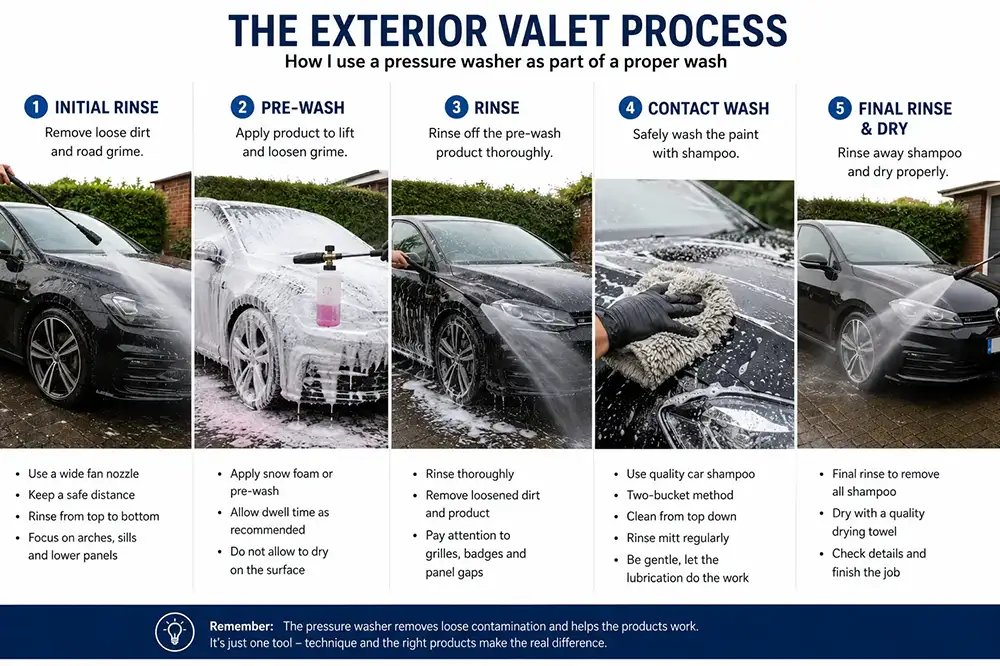
The exact process depends on how dirty the vehicle is, but I may be using the pressure washer several times during the job.
I might initially rinse away loose contamination, apply a suitable pre-wash, rinse again, carry out the contact wash with proper car shampoo and clean wash media, and then use the pressure washer for the final rinse.
The car still needs to be dried properly afterwards.
Wheels, arches and particular contamination can require their own products and methods as well.
Tar is a good example. Iron contamination is another. If something is chemically bonded to the surface, my answer isn’t automatically more water pressure.
So when somebody says they’ve “pressure-washed the car”, I wouldn’t necessarily regard that as the same thing as having properly washed or valeted it.
A pressure washer removes a lot of the loose dirt. A proper exterior valet deals with the whole vehicle and the contamination that’s left behind.
If you want that complete process carried out rather than simply pressure-rinsing the car, my valeting packages explain the different levels of cleaning I offer.
Can a pressure washer damage the paint?
Yes, if it is used incorrectly.
That doesn’t mean normal pressure washing is inherently harmful to sound modern automotive paint.
There is a big difference between properly bonded factory paint and paint that is already failing.
If I find peeling lacquer, flaking paint, corrosion underneath a damaged edge or a previous repair that’s beginning to lift, I change the way I work around it.
I don’t put a concentrated high-pressure jet directly into the edge of failing paint.
Once water gets underneath something that’s already lifting, it can make an existing defect worse.
Nilfisk’s pressure-washing guidance specifically warns against pressure-washing flaking or rusty paintwork and advises against unsuitable turbo-style nozzles on vehicle paintwork.
So if somebody has used a pressure washer sensibly on sound paintwork, I wouldn’t tell them they’ve done something dangerous.
The problems usually start when the wrong nozzle, excessive proximity or an already vulnerable surface gets involved.
The nozzle makes a big difference
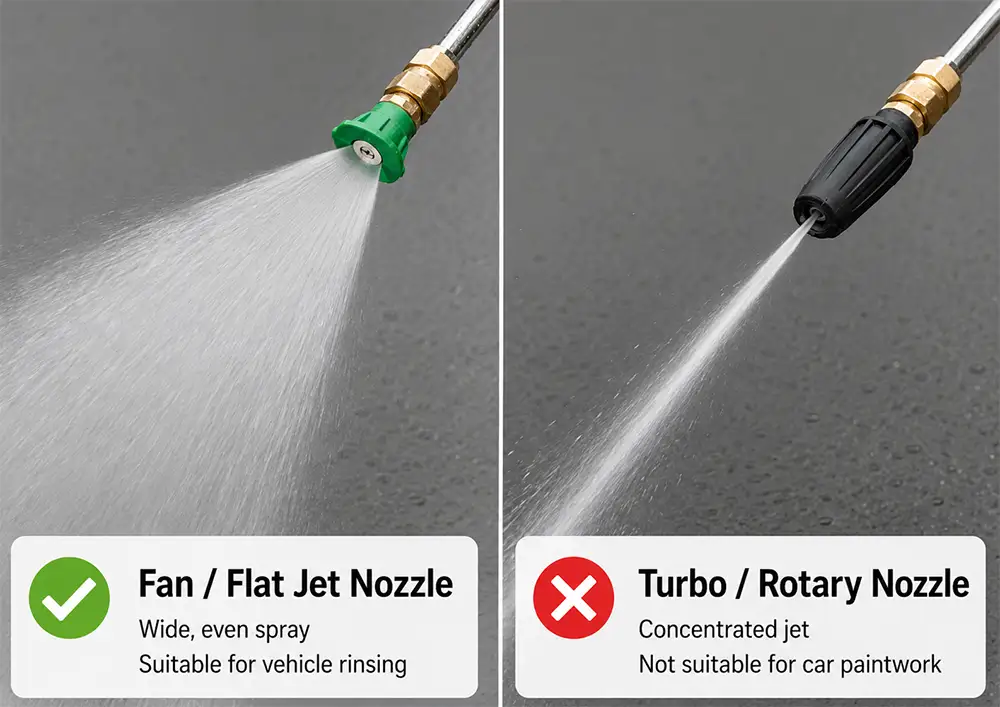
This is probably one of the most useful things to understand before pointing a pressure washer at a car.
For routine vehicle rinsing, I want a wide fan of water.
I don’t use a turbo, rotary or dirt-blaster nozzle on car paint.
Those nozzles concentrate the cleaning action into a much more aggressive jet. They’re useful for hard surfaces and stubborn outdoor cleaning, but that doesn’t make them appropriate for a painted vehicle.
Both Kärcher and Nilfisk distinguish between the normal fan-type jet used for vehicle cleaning and more aggressive rotary or dirt-blasting attachments.
If normal pressure and a suitable fan jet aren’t shifting something from the paint, I don’t immediately assume I need a more powerful nozzle.
I ask what I’m actually trying to remove.
If it’s tar, fallout or another bonded contaminant, the answer may be the right chemical treatment rather than more force.
That’s a much safer way of approaching it.
How close should the pressure washer be?
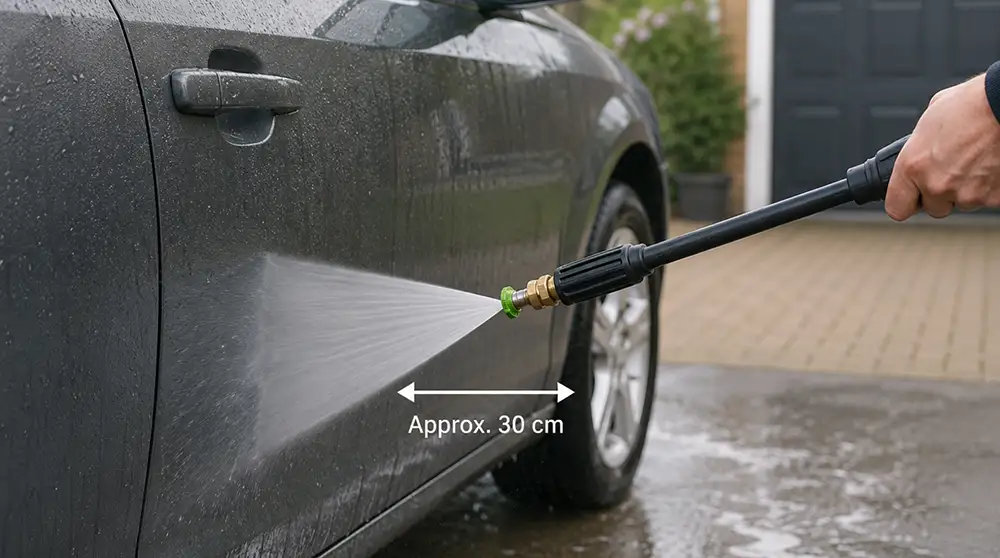
This is where I would be wary of anyone giving one number and claiming it applies to every pressure washer.
Machines vary.
Their pressure and water flow vary. Nozzles vary. Even manufacturer instructions vary between machines and attachments.
Kärcher’s general car-washing guidance allows closer working distances with certain suitable flat-jet attachments, while some machine manuals specify around 30 cm from painted surfaces. Nilfisk also recommends around 30 cm in its vehicle guidance.
That tells me something useful: the correct distance depends partly on the equipment being used.
Personally, around 30 cm or more is a sensible cautious starting point for me on paintwork. I can then assess the spray pattern, the surface I’m dealing with and the manufacturer’s guidance for the particular machine and nozzle.
What I don’t do is start with the end of the lance almost touching the car.
If I’ve got to move that close to remove a mark, there’s a good chance I should be thinking about a different cleaning method instead.
I also keep the lance moving rather than concentrating the jet unnecessarily on one small area.
More pressure isn’t always better
This is where car washing and patio cleaning part company.
A pressure washer can be surprisingly powerful, and I can understand the temptation to turn everything up and see how quickly it shifts the dirt.
But maximum cleaning force isn’t the objective.
Safe removal of contamination is.
If ordinary road grime is coming away at sensible pressure, I gain nothing by doubling the aggression.
And if something isn’t coming away, there may be a reason.
Tree sap, tar, iron fallout, hardened insect remains and other contamination can require specific treatment. Trying to compensate for the wrong cleaning method by moving a pressure washer closer to the paint isn’t something I’d recommend.
Knowing when to stop pressure washing is just as useful as knowing how to start.
I don’t put the lance against tyres either
Tyres look strong enough to take almost anything, but that doesn’t mean I treat them carelessly.
Kärcher and Bosch both give guidance about keeping high-pressure jets a sensible distance from tyres and tyre valves rather than holding the nozzle point-blank against them.
I still use the pressure washer to rinse wheels and tyres.
I just don’t put a concentrated jet virtually against a tyre sidewall or valve and hold it there.
There is no need.
Proper wheel and tyre cleaning comes from using the right cleaner, agitation where required and thorough rinsing — not trying to blast everything off at point-blank range.
I look at the car before pulling the trigger
This is something I think gets overlooked in generic advice.
Cars aren’t all in the same condition.
Before pressure washing one, I’ll notice things such as peeling lacquer, corrosion, damaged trim, loose badges, deteriorated seals or paint repairs that don’t look particularly secure.
An older car can have repairs that aren’t obvious until you’re standing close to it.
If an edge is already lifting, I back away from it.
If a badge is barely attached, I’m not going to test how well the adhesive is holding with a pressure washer.
It’s simply a matter of looking at what you’re about to clean rather than assuming every surface can take exactly the same treatment.
Under the bonnet is a different job
I don’t regard opening the bonnet and spraying everything with a pressure washer as engine bay detailing.
There are electrical connectors, sensors, air intakes and other areas that need consideration.
The AA warns that close-range pressure can damage plastics, force water beyond seals and potentially introduce water into electrical components.
That’s broadly how I approach it myself.
That’s why I treat engine bay detailing as a controlled cleaning job rather than simply another place to point the lance.
Engine bay detailing is about managing water, protecting sensitive areas and cleaning according to what is actually in front of me.
Pre-wash is where a pressure washer becomes particularly useful
On a dirtier vehicle, I may use an automotive pre-wash or snow foam before the contact wash.
The purpose isn’t to see how thick I can make the foam.
I’m interested in what it does to the contamination.
If the product loosens road film and grime so that more of it can be pressure-rinsed away before my wash mitt reaches the paint, it has done something useful.
That’s one of the reasons pressure washing fits so well into a careful washing method.
Pre-wash loosens contamination.
The pressure washer removes a proportion of it.
The contact wash deals safely with what remains.
I then rinse the vehicle thoroughly.
Those stages work together.
The pressure washer isn’t competing with car shampoo and it isn’t replacing the wash mitt. Each is doing a different job.
I use proper automotive shampoo for the contact wash, and I’ve already explained why I don’t substitute household detergent in Can I Use Washing-Up Liquid to Wash My Car?.
A few things I would and wouldn’t do
| I would | I wouldn’t |
|---|---|
| Use an appropriate wide fan jet | Use a turbo or dirt-blaster nozzle on paint |
| Start from a sensible working distance | Put the nozzle virtually against the panel |
| Remove loose dirt before contact washing | Start rubbing heavily contaminated paint |
| Keep the lance moving | Hold high pressure on one small area |
| Inspect the paint before starting | Blast directly into peeling lacquer or paint |
| Keep sensible distance from tyres and valves | Hold the jet point-blank against a tyre |
| Use the correct product for stubborn contamination | Assume more pressure will solve everything |
| Treat the pressure washer as one part of the valet | Assume pressure rinsing alone is a complete exterior wash |
That’s really the approach I follow.
Nothing particularly complicated, but no unnecessary risks either.
Can I wash a car without a pressure washer?
Absolutely.
A garden hose with a suitable spray attachment can still remove loose dirt and rinse shampoo from a vehicle.
I like pressure washers because they make pre-rinsing, wheel-arch cleaning and rinsing awkward areas much easier.
But I’d rather see somebody use a hose, proper car shampoo and good technique than buy the most powerful pressure washer they can find and use it badly.
The machine isn’t what makes the wash safe.
The method does.
For me, a pressure washer is one of the most useful tools in exterior valeting because it lets me remove a considerable amount of contamination before I ever put a wash mitt onto the paint.
I just don’t expect it to do every part of the job.