
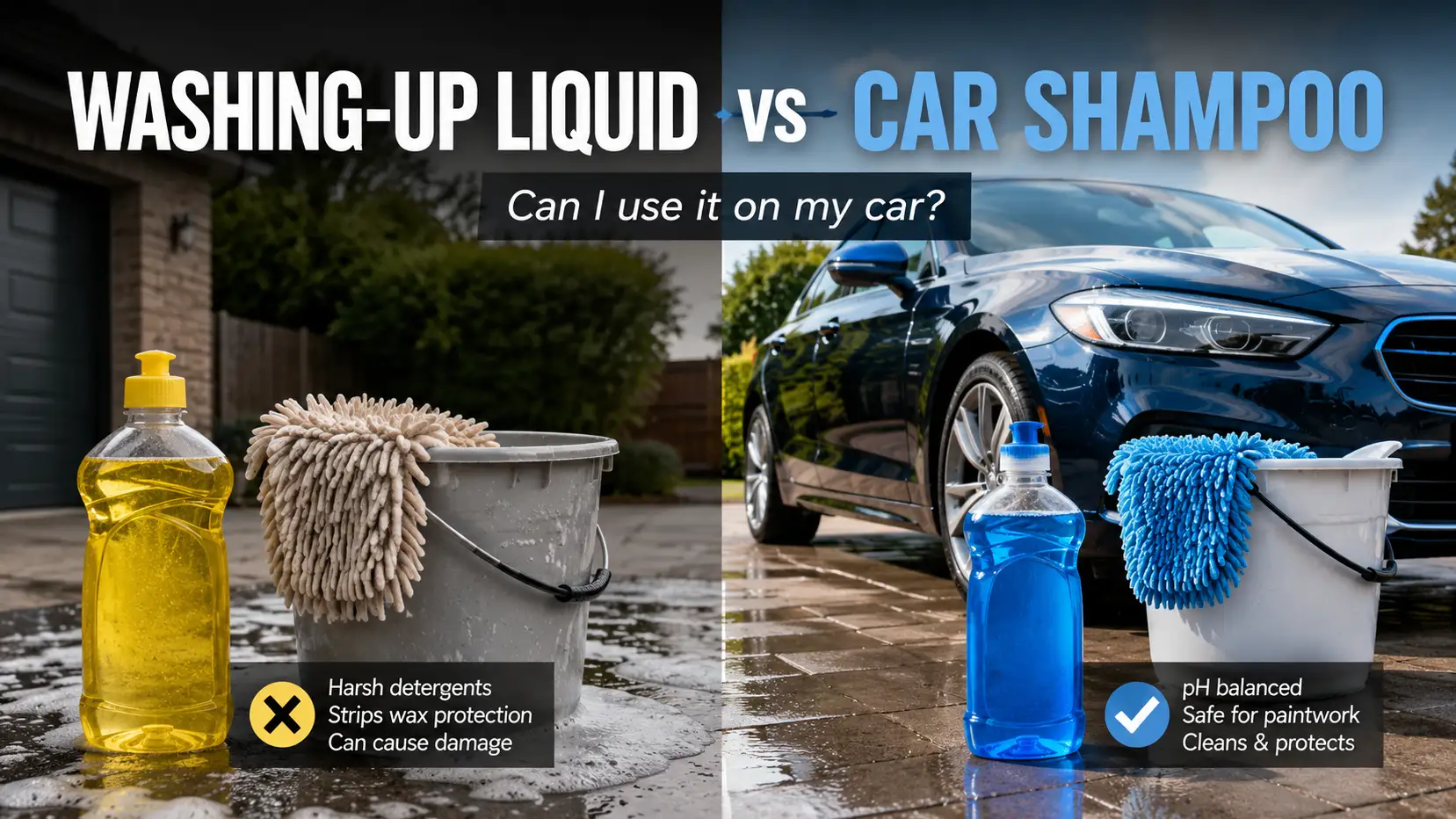
You can wash a car with washing-up liquid and it will certainly remove dirt and grease, but I don’t recommend using it for regular car washing.
If you’ve already done it once, though, don’t panic. You’re very unlikely to have suddenly ruined sound modern factory paintwork.
The problem isn’t that washing-up liquid somehow eats through clear coat the moment it touches the car. My concern is what it is designed to do, what it may do to protection already on the paint, and what I want from a product when I’m physically moving a wash mitt over a dirty panel.
Washing-up liquid and car shampoo might both make soapy water, but they’re designed for completely different jobs.
Washing-up liquid is very good at what it does
I use washing-up liquid at home for exactly the reason most people do: it’s excellent at cutting through food grease and oils.
That’s useful on a frying pan.
It’s not necessarily what I want when I’m maintaining vehicle paintwork.
When I’m washing a car, cleaning ability is only part of what I’m looking for. I’m also thinking about the wax, sealant or coating that may already be on the paint and, just as importantly, what is happening while I move the wash mitt across the surface.
A proper automotive shampoo is formulated with that job in mind.
One of the biggest differences for me is lubrication.
When there is road dirt sitting on paintwork, some of that contamination can be abrasive. The less friction I create while removing it, the better.
That’s one reason I don’t judge shampoo by how many bubbles it produces. A bucket overflowing with foam might look impressive, but I’m much more interested in how the wash mitt feels as it moves across the panel.
Can washing-up liquid actually damage car paint?
This is where I think some online advice goes too far.
If somebody tells me they’ve washed their car once with washing-up liquid, I’m not going to tell them they’ve destroyed the paint.
On sound modern factory paint, one diluted wash is very unlikely to suddenly cause the clear coat to peel, fade or chemically fail.
The AA gives similar advice in its guide to washing a car. It notes that ordinary washing-up liquid shouldn’t normally remove or dull the paintwork itself, although non-specialist cleaning products may strip wax protection.
That distinction is important.
What concerns me more is repeated use.
Household washing-up liquids are designed to remove oils and grease. Depending on the particular detergent, concentration and protection already on the vehicle, repeated washing may weaken wax protection or shorten the useful life of some protective products.
There is an important difference between affecting something sitting on top of the paint and damaging the paint itself.
If a detergent removes some wax, for example, the clear coat underneath hasn’t necessarily been damaged. But some of the sacrificial protection that was deliberately applied to the car may now be gone.
I don’t see much sense in applying protection to a car and then routinely washing it with something that isn’t intended to maintain it.
Washing-Up Liquid vs Car Shampoo
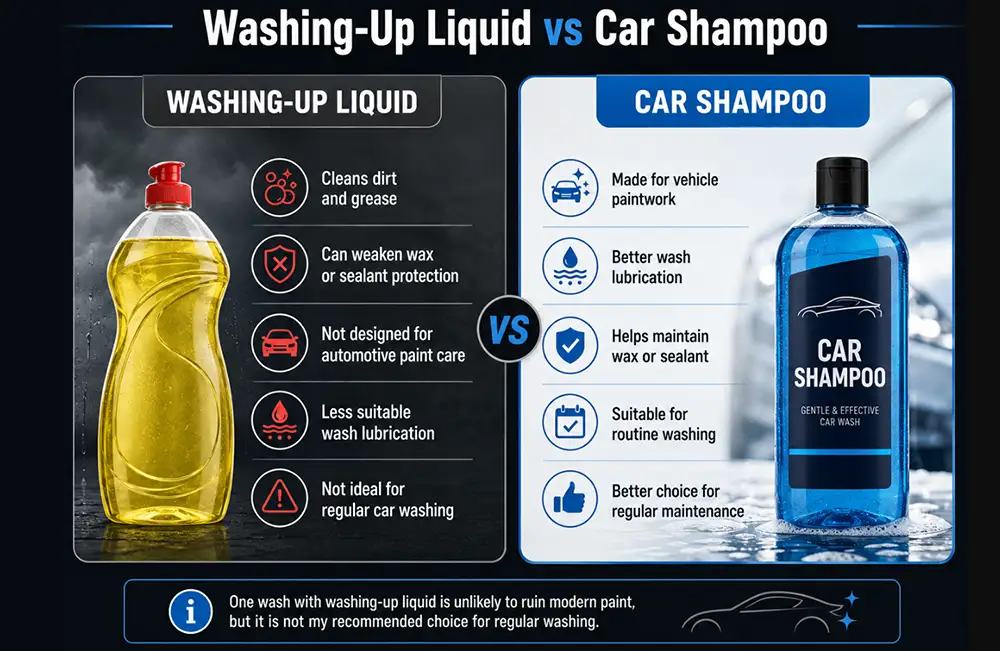
There are several reasons I stick with proper car shampoo.
❌ It can weaken or remove some wax protection
Wax is supposed to sit above the paint as a sacrificial protective layer.
A strong grease-cutting detergent isn’t what I would choose to maintain that layer.
❌ It may shorten the life of some sealants
Different sealants have different chemical resistance, so I wouldn’t claim washing-up liquid affects every product in exactly the same way.
The simpler point is that household detergent hasn’t been formulated specifically to maintain automotive sealants.
❌ You can end up with less protection on the paint
This is where the distinction matters.
Losing wax or sealant doesn’t automatically mean you’ve damaged your clear coat.
It means the clear coat may now have less protection sitting above it.
❌ It isn’t designed specifically around contact washing car paint
When I’m physically moving dirt across paintwork, I want good lubrication.
Quality automotive shampoos are developed with that process in mind.
❌ Poor washing technique can cause swirl marks
I wouldn’t say washing-up liquid itself creates swirl marks.
The scratching comes from contamination being moved against the paint.
The shampoo, the amount of lubrication, your wash mitt, how much dirt you’ve removed beforehand and your washing technique all affect that risk.
If fine wash marks and swirls have already built up, paint correction and machine polishing may improve or remove some of them depending on their depth and the condition of the paint.
❌ Using more detergent isn’t automatically better
I’ve seen people judge cleaning products by how strong they can make the bucket.
I don’t.
With automotive shampoo I use the manufacturer’s recommended dilution. If a car needs stronger cleaning, I’d rather deal with the actual contamination properly than keep adding more shampoo.
Why I prefer a proper car shampoo
There are plenty of good automotive shampoos available, and I don’t believe there’s one bottle that’s automatically the best choice for every car.
For ordinary maintenance washing, Bilt Hamber Auto-Wash is a good example of what I mean by a straightforward shampoo.
It’s highly concentrated, with Bilt Hamber recommending around 5 ml in up to 10 litres of water. The manufacturer describes it as wax and additive free, with surfactants intended to help lift particulate contamination away from the paint.
That doesn’t mean everybody has to buy Bilt Hamber. I mention it because it demonstrates something I think is important: a good shampoo doesn’t need to rely on huge quantities of product or flashy claims.
The right shampoo depends on what is already on the car and what I’m trying to achieve.
What I actually look for when choosing shampoo
I don’t choose purely by brand name.
There are a few things I pay much more attention to.
Is it intended for automotive paintwork?
This sounds ridiculously obvious, but it’s really the heart of the washing-up-liquid question.
If I’m working on vehicle paint, I want a product designed for vehicle paint.
How well does it lubricate?
This is high on my list.
I’m putting a mitt onto a surface that may still contain tiny particles of contamination. I want as little unnecessary friction as possible.
What protection is already on the car?
If the car has wax, sealant or a ceramic coating, I take that into account.
I want to know that the shampoo is appropriate for what I’m maintaining.
Does it leave anything behind?
Not every shampoo is trying to do the same job.
Some are straightforward cleaning shampoos.
Others contain waxes, gloss enhancers or other ingredients intended to leave something behind after washing.
Neither approach is automatically better. It depends on what I want from that particular wash.
Personally, I think it’s useful to understand the difference rather than assume every bottle labelled “car shampoo” contains roughly the same thing.
What’s the actual dilution?
A £20 bottle used at a very high dilution can work out cheaper per wash than a £10 bottle that needs considerably more product.
I look at how much shampoo I’m actually supposed to put into the bucket rather than judging value from the shelf price alone.
And I follow the instructions.
If the manufacturer says 5 ml, I don’t see a benefit in chucking 50 ml in because more must somehow be better.
What about a ceramic-coated car?
I would be even less inclined to experiment with household detergent on a car that’s already had a ceramic coating applied.
I’m not saying washing-up liquid will automatically strip every ceramic coating. That would be too broad a claim.
Ceramic coatings differ in formulation and chemical resistance.
My approach is simply to use a shampoo designed to work with that type of protection.
CARPRO Reset is a good example. It was developed specifically for maintaining ceramic coatings. CARPRO describes it as pH-neutral in solution, with strong lubrication and no gloss enhancers left behind.
That makes sense to me.
If I’ve gone to the trouble and expense of coating a car, I’d rather maintain it with something designed for the job than see what happens with the bottle next to the kitchen sink.
Don’t assume pH-neutral means weak
You’ll often see people recommending a pH-neutral shampoo, particularly for regular maintenance washing.
That’s generally sensible advice, but I don’t think the words “pH-neutral” tell you everything you need to know about a shampoo.
CARPRO Reset is a good example of why.
It’s pH-neutral in solution but is still designed to deal effectively with dirt and traffic film.
A shampoo is a complete chemical formulation. Its surfactants, lubricity, dilution and intended use all matter.
So I wouldn’t stand in a shop comparing bottles and simply pick whichever one shouts “pH-neutral” the largest on the label.
If the car is filthy, I change the process rather than just making the shampoo stronger
This is something I think makes far more difference.
If a car is heavily contaminated, I want to remove as much dirt as I reasonably can before I start rubbing a mitt across the paint.
That can mean a thorough initial rinse and, where appropriate, a proper automotive pre-wash.
There may also be particular contamination that needs its own treatment.
Tar is different from general road dirt. Iron contamination is different again. Heavy traffic film may need something more than normal maintenance washing.
I’d rather identify the problem and use the right product than expect one bucket of increasingly concentrated shampoo to deal with everything.
What if I’ve already used washing-up liquid?
I’d carry on with my day.
Seriously, if you’ve washed a sound modern car once with washing-up liquid, there’s normally no reason to start assuming you’ve ruined the paint.
Rinse it properly if you’ve only just washed it and use a proper automotive shampoo next time.
If the car had previously been waxed or sealed, I’d also keep in mind that some of that protection may have been affected. That doesn’t automatically mean it has all disappeared either.
What I wouldn’t do is start polishing or applying products unnecessarily because you’ve read somewhere that one wash with washing-up liquid destroys clear coat.
That’s replacing one mistake with another.
For me the question isn’t really “Will washing-up liquid get my car clean?”
It will.
The better question is “Why would I use it when proper car shampoo has been designed specifically for the surface I’m cleaning?”
That’s why washing-up liquid stays in my kitchen and car shampoo stays with my car-cleaning products.