
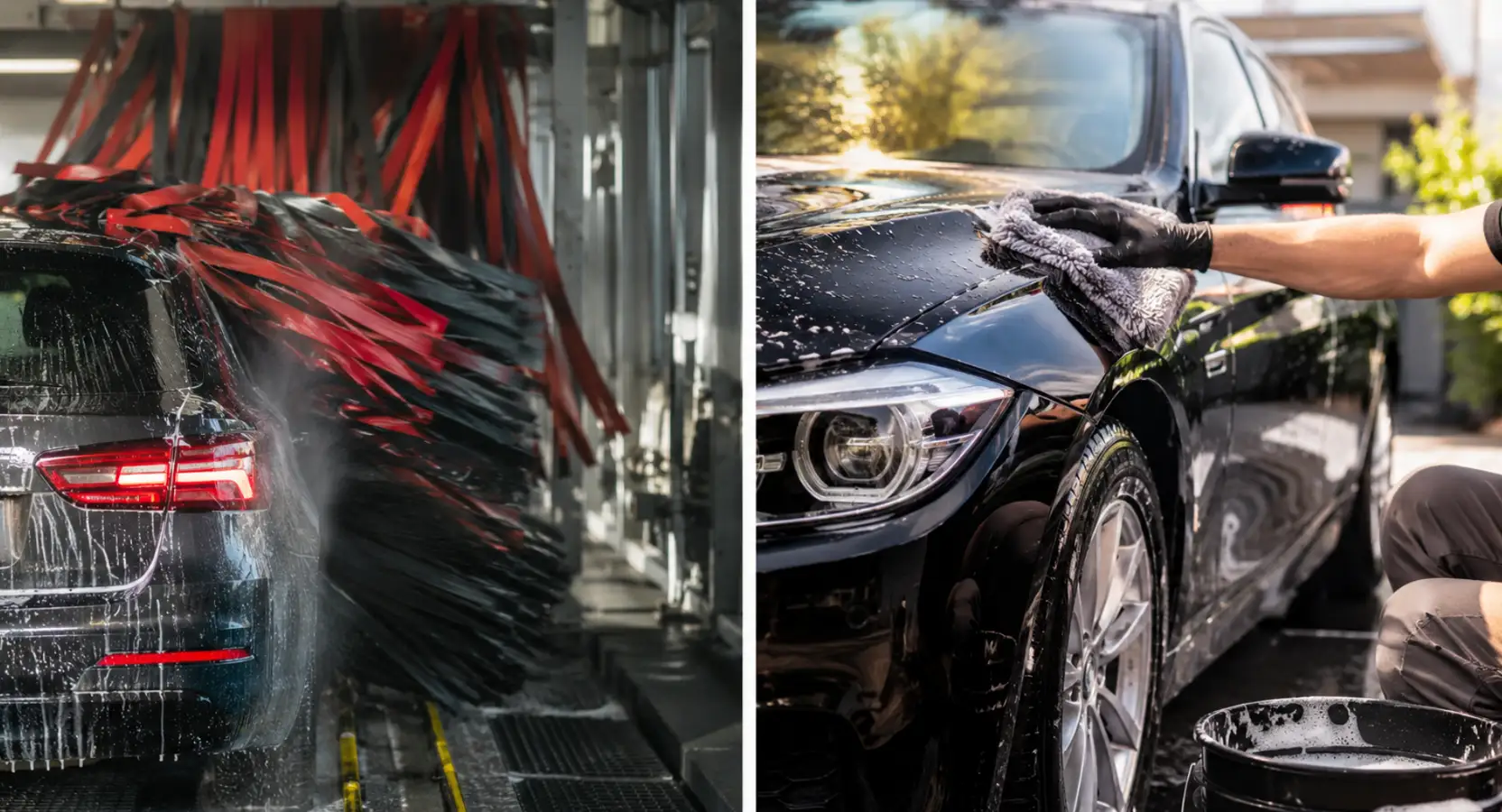
Yes, automatic car washes that physically brush or wipe against the car can cause fine scratches and swirl marks in paintwork, and repeated use can make those defects increasingly noticeable.
That doesn’t mean every car will come out of every automatic wash visibly scratched after one visit. The condition of the wash equipment, how well the car is pre-rinsed and how dirty the vehicle is all make a difference.
But if somebody asks me whether I would regularly put a car through a contact automatic wash when I wanted to preserve the paint finish, my answer is no.
The reason is fairly straightforward: I don’t want shared wash material repeatedly rubbing across dirty paint when I have no control over how clean that material is.
There is more than one type of automatic car wash
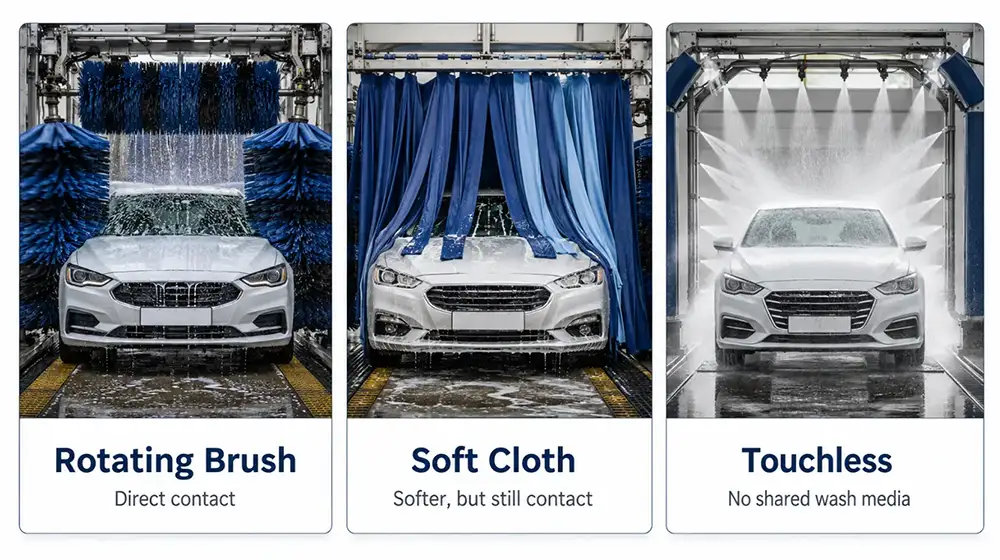
It’s useful to separate them because they don’t all clean the car in the same way.
| Type of automatic wash | How it cleans | My view |
|---|---|---|
| Rotating brush or filament wash | Rotating material physically scrubs the vehicle | Highest concern for paint marring |
| Soft-cloth or foam-strip wash | Softer hanging strips wipe and slap across the bodywork | Gentler, but still a contact wash |
| Touchless wash | Chemicals and pressurised water clean without brushes or cloth touching the paint | Lowest contact-scratch risk, but with other compromises |
The first two are both what I would call contact or friction washes.
The material may be very different, but something is still physically moving across the paint.
That distinction matters.
Why rotating brush washes have the reputation they do
Traditional automatic washes use rotating brushes or flexible filaments that travel over the car as it moves through the machine.
The concern isn’t simply that a brush touches the paint.
It’s what can happen when dirt gets involved.
Road grime can contain grit and other hard particles. Lower doors, sills and the back of a car can be particularly contaminated. If that dirt isn’t removed before physical washing begins, some of it can be caught between the wash material and the clear coat.
It then gets moved across the paint.
The RAC currently warns in its guidance on looking after a car that automated washes with stiff brushes may leave fine scratches. Its separate washing guidance also recommends removing loose dirt before contact washing because trapped grit can cause scratches and swirl marks.
That fits with how I approach washing a car myself.
I want as much loose contamination off the vehicle as reasonably possible before I start physically touching the paint.
Soft cloth is better, but it doesn’t remove the problem
More modern automatic washes often advertise soft cloth, foam or similar flexible strips instead of the traditional brush.
They can certainly be gentler.
But I think the word “soft” sometimes gives people the impression that scratching is no longer possible.
The material can be perfectly soft when it’s clean.
What I’m interested in is what happens after it has repeatedly made contact with dirty vehicles.
Imagine a vehicle covered in winter road grime goes through before yours. The wash material cleans its lower panels, wheels and rear bodywork. Your car then enters the same machine.
A good car wash should have systems for rinsing and cleaning its wash media, and a properly maintained modern installation can be considerably better than an old neglected brush wash.
But I still don’t know what is sitting in that material when it reaches my paint.
That’s the difference for me.
If I’m washing by hand and my wash mitt becomes contaminated, I can rinse it thoroughly or replace it. If I drop it on the driveway, I’m not going to pick it up and immediately rub it across a bonnet.
With an automatic wash I have handed that control over to the machine.
Can repeated automatic washing really create swirl marks?
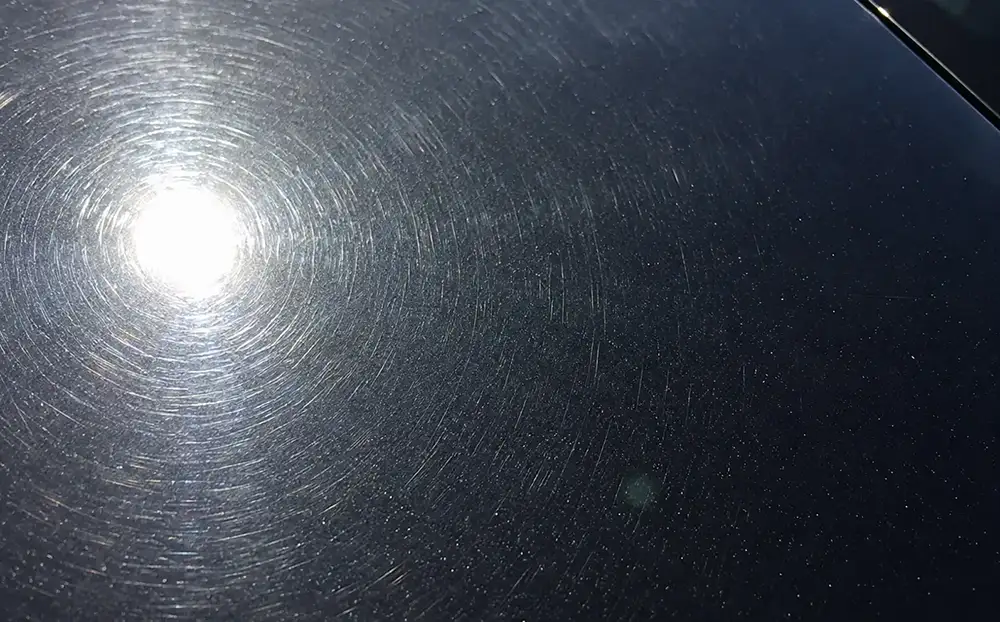
Yes, repeated poor contact washing can contribute to the accumulation of fine scratches and the appearance we commonly call swirl marks.
It helps to understand what you’re actually seeing.
Swirl marks aren’t necessarily individual circular scratches carved into the paint by a rotating brush.
Normally you’re looking at lots of extremely fine scratches running in different directions through the surface of the clear coat. When strong sunlight or another concentrated light source reflects from them, they can appear as circular or spider-web patterns around the light.
You tend to notice them particularly easily on black, dark blue and other darker paint colours.
One wash may introduce little or no visible marring.
Another might introduce a small amount.
Do that repeatedly and the defects can accumulate.
Eventually a car can be perfectly clean but still look duller under direct light because the surface is covered in fine wash marks.
This is one reason I think saying “I’ve used that car wash before and it didn’t scratch my car” doesn’t necessarily tell the whole story.
You may not notice fine marring immediately.
Look at the same clean bonnet in bright sunlight after repeated contact washing and the picture can be rather different.
Hand washing can cause exactly the same problem
Automatic car washes get most of the criticism, but I don’t think it would be fair to pretend hand washing is automatically safe.
It isn’t.
Take a dirty sponge, put it into one bucket, rub it over the lower half of the car, put it back into the same increasingly dirty water and then wipe the bonnet with it.
You’ve created many of the same conditions I’m trying to avoid in an automatic wash.
Poor drying technique can introduce marks as well.
The advantage of a careful hand wash isn’t simply that there is a person involved.
It’s that I can control the process.
I can remove loose contamination first, use appropriate car shampoo, keep the wash media clean, work from cleaner areas towards dirtier ones and avoid unnecessarily grinding contamination against the paint.
That’s what makes the difference.
What about a touchless automatic car wash?
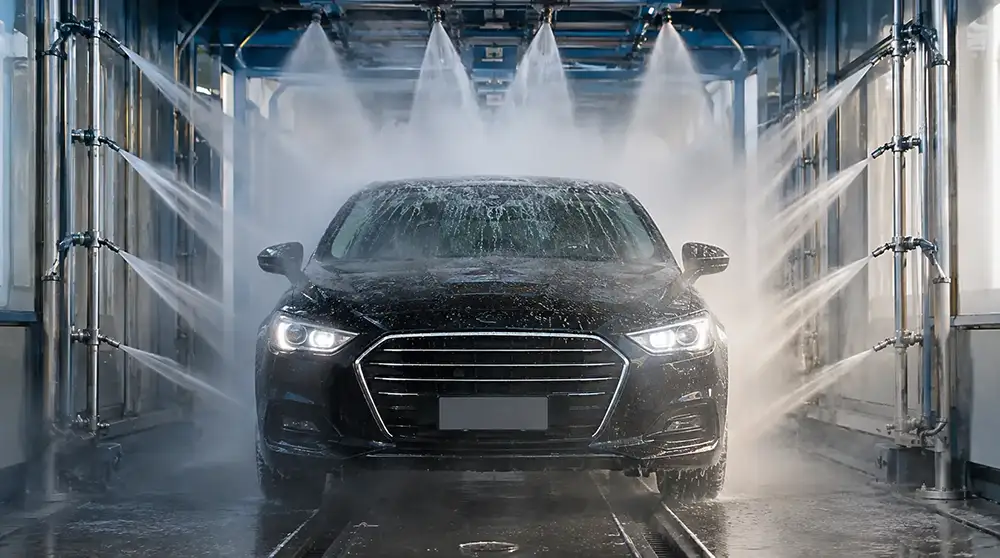
Touchless washes solve one of my main objections because no shared brushes, cloths or foam strips physically scrub the vehicle.
They rely instead on cleaning chemicals, water pressure and rinsing.
If my only concern were the risk of wash media physically dragging contamination over the paint, I’d choose touchless over a conventional contact automatic wash.
But it isn’t a perfect system.
Without physical agitation, the chemicals and water have to do more of the cleaning.
That can mean stronger cleaning chemistry than I would normally use for a gentle maintenance hand wash.
And because nothing physically agitates the surface, some stubborn road film may remain.
A car can therefore come out looking considerably cleaner without necessarily being as thoroughly clean as it would be after a well-executed contact wash.
So for me:
touchless doesn’t mean perfect;
it means I’ve removed one of the main sources of mechanical wash marring.
That’s still a worthwhile advantage.
Could touchless chemicals affect wax or other protection?
Potentially, depending on the chemistry being used and the protection already on the car.
I wouldn’t make the sweeping statement that touchless car washes damage automotive paint. Modern vehicle paint is designed to withstand normal vehicle washing.
But paint and paint protection aren’t the same thing.
Wax, sealants and ceramic coatings have different formulations and different levels of chemical resistance.
A stronger cleaner might shorten the useful life of some waxes or sealants without having damaged the underlying clear coat at all.
If I’ve deliberately applied protection to a vehicle, I prefer to maintain it with products and a washing process I understand.
What if my car already has swirl marks?
If you look at a clean car in strong sunlight and see a network of fine marks around the reflection, washing may well have contributed to them over time.
That doesn’t automatically mean the paint needs repainting.
Some defects confined to the clear coat can be substantially improved through paint correction and machine polishing, depending on their depth, the condition of the paint and how much safe correction is available.
Deeper scratches are a different matter.
Polishing isn’t a magic way of removing every mark from every vehicle, and I wouldn’t chase a deep defect at the expense of unnecessarily removing clear coat.
Prevention is preferable.
If I’ve spent several hours correcting a car’s paintwork, the last thing I’d personally do afterwards is repeatedly run it through a contact automatic wash.
Would I put an expensive or particularly well-kept car through one?
If preserving the finish mattered to me, no.
And that isn’t really about the badge on the bonnet.
The same applies whether it’s an expensive performance car, a cherished twenty-year-old car or an ordinary family car that’s just had its paintwork corrected.
If somebody has invested time or money getting the paint into very good condition, it makes sense to wash it in a way that tries to preserve that condition.
You don’t generally see owners who are particularly particular about high-end paint finishes deliberately looking for more uncontrolled contact with the paint.
That doesn’t mean nobody has ever taken a Bentley or Ferrari through an automatic wash.
I’m sure somebody has.
It’s simply not the washing method I would choose for a finish I was deliberately trying to preserve.
Are automatic washes ever useful?
Of course.
Convenience is their biggest advantage.
Not everybody has a driveway, hose, pressure washer or an hour available to wash a car properly.
There are also occasions when removing contamination promptly is more important than waiting indefinitely for perfect washing conditions.
Winter road grime is a good example.
If my choice were between leaving a car covered in salt and grime for months or putting it through a decent touchless wash periodically, I’d rather remove the contamination.
A working vehicle that needs to be presentable quickly may be another perfectly reasonable candidate for an automatic wash.
The question is what matters most to the owner.
If speed and convenience are the priority, an automatic wash makes sense.
If maintaining the best possible paint finish is the priority, I’d choose differently.
My order of preference
If I had the options available to me, I’d put them in this order.
- A careful hand wash using a sensible pre-wash and clean wash media.
- A well-maintained touchless automatic wash when hand washing isn’t practical.
- A reputable, well-maintained modern soft-cloth wash if I really needed a contact automatic wash.
- An old or questionable rotating-brush wash would be my last choice.
That doesn’t mean option three scratches every car and option one can never cause damage.
A poor hand wash can be worse than a very good automatic wash.
It’s about reducing the opportunities for contamination to be dragged across the paint.
If you’d rather have the vehicle cleaned without relying on a shared automatic contact wash, my valeting packages cover the regular exterior and interior cleaning options I offer.
For my own washing, the decision is fairly simple.
I can control my shampoo, my wash mitt, my pre-wash, how much pressure I use and exactly what touches the paint.
An automatic contact wash takes most of those decisions away from me.
That’s why I don’t use one when preserving the paintwork matters.